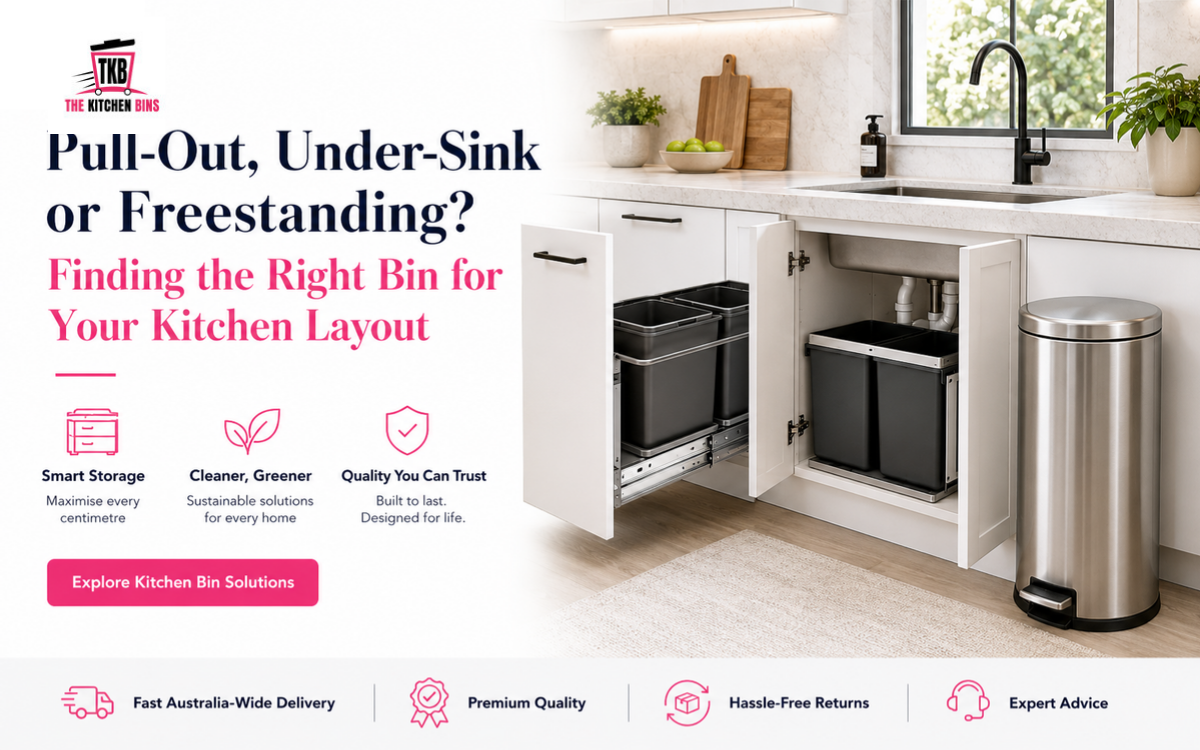
Bin placement affects more than where rubbish goes. It influences walkway space, food-preparation flow, cleaning and the amount of cabinetry available for other items.
Comparing kitchen bins by layout rather than appearance makes it easier to find an option that works naturally with the room.
Option One: Freestanding Bins
A freestanding bin is the simplest choice.
There is no cabinet installation, and the bin can be moved whenever the kitchen layout changes.
This can suit:
- Rental properties
- Large kitchens
- Utility spaces
- Households needing high capacity
- Kitchens with limited cabinet space
The main disadvantage is floor-space use.
Option Two: Pull-Out Systems
A pull out bin sits inside cabinetry and moves toward the user on a sliding mechanism.
Why Pull-Out Access Is Useful
Deep cabinets can make ordinary containers difficult to reach.
Pulling the entire unit forward can simplify:
- Waste disposal
- Liner changes
- Recycling separation
- Cleaning access
Check Space in Front of the Cabinet
The unit needs room to extend fully.
If an island sits close to the cabinet, measure the walkway before choosing a system.
Option Three: Under-Sink Bins
The sink cabinet is attractive for waste storage because it is usually near food preparation and cleaning.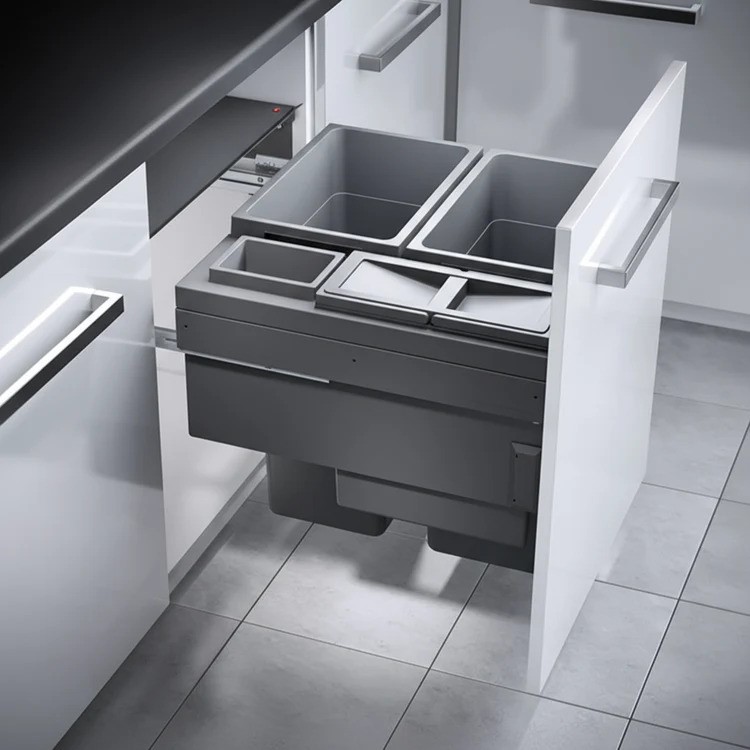
However, plumbing reduces usable volume.
An under sink bin must fit around pipes, traps and other equipment.
Measure Around the Obstacles
Measure the actual free space rather than the nominal cabinet size.
Include:
- Plumbing
- Hinges
- Water filters
- Cleaning products
- Door supports
A smaller carefully positioned system may work better than a large container that technically fits but cannot be removed easily.
Match Bin Position to Workflow
Think about where waste is created.
If most vegetable preparation happens on one side of the kitchen, placing kitchen bins nearby can reduce unnecessary movement.
Observe One Meal Preparation Session
Watch what happens while cooking.
Where do you:
- Unwrap ingredients?
- Peel vegetables?
- Scrape plates?
- Sort recycling?
- Clean the worktop?
This quick exercise can reveal the most convenient bin location.
Capacity Should Reflect Habits
A large household does not always require the largest possible container.
If rubbish is removed frequently, a smaller bin may be sufficient.
Conversely, a tiny integrated bin can become frustrating if it needs emptying several times a day.
Compare capacity against:
- Household size
- Food preparation
- Recycling habits
- Collection frequency
- Available cabinet space
Consider Recycling
Integrated waste systems can divide cabinet space into multiple containers.
A pull out bin with two or more sections can make sorting convenient, but only if the capacity allocation matches your household.
Do not choose extra compartments simply because they are available.
Cleaning Is Part of the Decision
Freestanding models are generally easy to move for cleaning.
Integrated models should have removable buckets and enough cabinet access to wipe spills.
An under sink bin also shares space with plumbing, so occasional checks for moisture or leaks are sensible.
Think About Liner Changes
Can the bucket be lifted straight out?
Check Clearance Above the Bin
Benchtops, sinks and plumbing can block vertical movement. Test this before installation.
What If You Have a Small Kitchen?
In a very compact room, floor area is often more valuable than internal cabinet space.
Moving waste into cabinetry may improve movement around the room.
However, if cupboard storage is already insufficient, a narrow freestanding option may be the better compromise.
Why Choose Us
Kitchen Bins provides waste-storage choices for different kitchen configurations, allowing households to compare integrated and conventional formats based on actual space.
The focus is on finding a practical relationship between capacity, cabinet fit and ease of everyday access.
About Us
Kitchen Bins specialises in kitchen waste-storage solutions, including options designed for cabinets and pull-out applications. We recognise that no single configuration suits every household because cabinetry and waste habits vary considerably.
Careful measuring helps customers select more confidently.
Conclusion
The right under sink bin or freestanding system depends on which space your kitchen can most easily spare.
Choose a pull out bin when cabinet access is a priority, consider under-sink storage when plumbing leaves enough room and use freestanding kitchen bins where flexibility and capacity matter most.